Overview
Display location:
- Hangar C, Cape Canaveral Space Force Station
Type: Surface-to-surface guided missile
Designation: SM-65
Payload: Nuclear warhead
Agency: U.S. Space Force
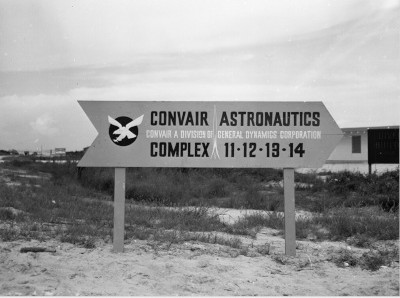
Contractor: Convair Division of General Dynamics in San Diego
Cape Canaveral Space Force Station Operations: 1957-1959 (A-C Variants), 1959-1961 (D), 1960-1964 (E), 1961-1964 (F)
General History
The SM-65 Atlas was the United States’ first operational intercontinental ballistic missile and one of the earliest large liquid-fueled rockets ever built. Developed in the 1950s by Convair, Atlas marked a major leap in both military technology and rocket engineering, forming the foundation of a launch vehicle family that would support American spaceflight for decades.
Early variants (Atlas A–C) were developmental and often unreliable—only three of eight Atlas A test flights were fully successful. Rapid improvements followed, and by 1959 Atlas had entered operational service. Later versions, including the D, E, and F models, demonstrated increasing reliability, though their dependence on cryogenic fueling required lengthy pre-launch preparation. Early missiles were stored at ground level in exposed or semi-hardened “coffin” structures, while later F-models were housed in underground silos and raised to the surface before launch. Despite these advances, Atlas was quickly rendered obsolete by solid-fueled systems like Minuteman and retired from its ICBM role by 1965.
Technically, Atlas was groundbreaking. Its “stage-and-a-half” design ignited all three engines at liftoff—two booster engines and a central sustainer—before discarding the boosters in flight. Its thin stainless-steel “balloon tank” structure required constant pressurization to maintain rigidity, an innovative solution that reduced weight while maximizing performance.
Though short-lived as a weapon system, Atlas found enduring success as a space launch vehicle. It carried the first American astronauts into orbit during Project Mercury and became the basis for rockets such as Atlas-Agena and Atlas-Centaur, establishing a legacy that continues in modern launch systems.
THE ATLAS AT CCSFM
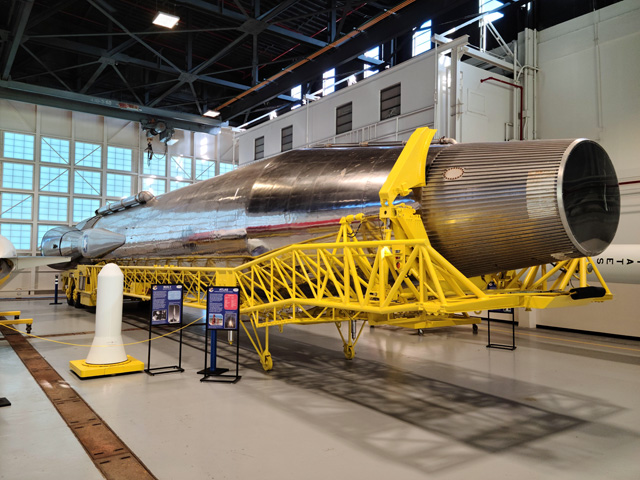
While this missile’s exact configuration remains unconfirmed, it is certainly part of the SM-65 Atlas family. Some evidence suggests it may be a later D or E model modified to resemble an early Atlas A — an alteration common for missiles repurposed for training or public display.
One historian has identified this missile as serial number 57-1771, a vehicle believed to have begun its life as a static firing test unit at Edwards Air Force Base on 28 October 1957. Following its testing role, it was converted for exhibition: engines were removed, the structure was rigidized, and an access door was cut into the boattail—features that reflect its transition from test article to display piece.
Over the following decades, the missile traveled extensively:
- World Congress of Flight, Las Vegas, NV (1959)
- Wright-Patterson Air Force Base, Dayton, OH – where it was reportedly modified to resemble a D-model Atlas.
- Davis-Monthan Air Force Base, Tucson, AZ (1963)
- Third National Conference on the Peaceful Uses of Space, Chicago, IL (1963)
- Paris Air Show, Paris, France (1965)
- International Verkehrsausstellung, Munich, Germany (1965)
After its international exhibitions, the missile returned to Wright-Patterson AFB, where modifications—including the removal of boattail access doors—were reportedly made. Later in 1965, it entered long-term display at the Franklin Institute in Philadelphia, remaining there until 1984. It was then returned to Wright-Patterson at the National Museum of the US Air Force, where it remained until the early 2000s, when the missile was transferred to the Cape Canaveral Space Force Museum, in exchange for an Atlas 10E.
Whether an early test article, a modified operational missile, or a composite shaped by decades of exhibition, this Atlas reflects not only the rapid evolution of missile technology, but also the global effort to interpret and display the dawn of the Space Age.
RESTORATION
The restoration of the Atlas was contracted to Blast Off Incorporated (BOI) of Perdido, Alabama in December 2011. At that time, the missile was in multiple parts (forward, center, and aft, plus two engines) and had been completely gutted of all internal components. It was to be rebuilt and restored alongside its M-52 Tractor, also known as a “Traveler.”
Work on the Atlas began a year later, in December 2012. BOI installed a Portable Maintenance Facility (PMF) on the grounds of Hangar C for stripping and painting. On 24 March 2013, a hurricane passed near Cape Canaveral and spun off a tornado, which then traveled through the restoration site and destroyed the PMF. The Atlas and its M-52 Tractor were not damaged. The restoration was completed June 2013.
THE WD-40 CONNECTION
WD-40 was developed in 1953 by the Rocket Chemical Company and its staff of three people in a small lab in San Diego, California. They were attempting to create a line of rust-prevention solvents and de-greasers for use in the aerospace industry.
“WD” stands for Water Displacement, and the number “40” represents the 40th attempt to devise a working formula.
Convair, an aerospace contractor, first used WD-40 to protect the outer skin of the Atlas missile from rust and corrosion.
Related Pages:
- Atlas Booster Engine
- Atlas Vernier Engine
- Atlas Radio Guidance System
- Burroughs MOD I Guidance Computer
- Atlas Archived Photography
- HANGAR C